The year of the pup: Pregnancy, birth, and the first two months at Bearhill Husky
At Bearhill Husky, raising puppies is not something that starts when they are big enough to look cute in photos. It starts even before they are born. Because it actually starts already with the mother.
When we raise a litter, the goal is not simply to produce dogs who can one day pull a sled. The goal is to raise confident, healthy, social, adaptable dogs who understand people, trust handling, cope with frustration, and know what is expected of them in daily life. That matters during their working life. It matters when they need veterinary care. It matters when they are living in groups with other dogs. And one day, when they retire, it will matter then as well.
So welcome to our puppy series: The year of the pup.
Over the next four articles, we will follow the journey from pregnancy and newborn pups all the way to young yearlings starting their first working season. It is a story of milk, mud, sharp teeth, tiny collars, forest walks, harnesses, bad decisions, good decisions, and a lot of patience.
Before the puppies are born
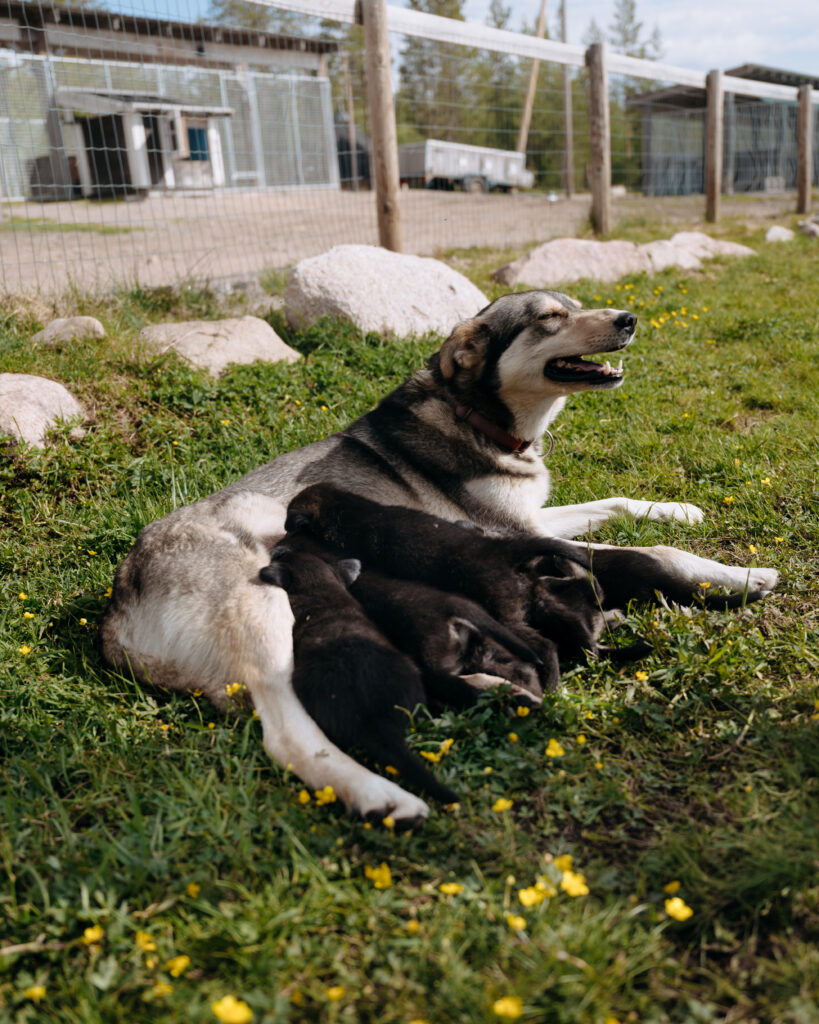
The puppies’ first home is their mother, so her care comes first.
During pregnancy, we keep the mother active, well fed, and closely observed. Around week seven or eight of pregnancy, her food amount is increased, because growing puppies takes energy. She still needs daily movement, but as the due date gets closer, the activity becomes easier and calmer.
At least one week before the due date, the mother moves to “puppy land”. Puppy land is an area in our kennel that is designed specifically for mothers to give birth and raise their pups, with a special type of dog house and a fenced-in play area. Moving the mother to this area already ahead of giving birth gives her time to settle into her new surroundings before labour begins. A dog who feels safe and undisturbed is much better prepared to give birth and to care for her litter.
We also follow the necessary health routines. The mother is dewormed during pregnancy, usually between days 40 and 42, counted from the last breeding. She may have an ultrasound around four weeks after breeding and an X-ray about a week before the due date so we have a better idea of what to expect.
But even with all the planning, birth is birth and dogs do not read our schedules.
During labour, the most important thing is calm. The mother needs fresh water, a quiet place, and as little stress as possible. Once the puppies are born, we give her time to rest. Later, she needs to move a little, even if she would rather stay glued to the puppies, because gentle walking helps her body recover.
Food and water must be easy for her to reach. She gets dry puppy food, fresh water, and peace. For the first weeks, peace is one of the best gifts we can give.
0-1 Month: Eat, sleep, poop, repeat
The first month is not glamorous.
Newborn puppies mostly eat, sleep, pee, poop, and repeat. Then they repeat it again. And again. And again.
Our job is to make sure the mother has what she needs and that the doghouse stays clean, dry, and calm. We do not allow visitors near newborn puppies in the first weeks. Not because we are trying to hide the cuteness (there is a lot of it!) but because the mother already has a huge job. Labour, nursing, cleaning, protecting, and raising a litter is enough stress. Strange people near the pups can make the mother anxious or protective, and that does not help anyone.
In this stage, one of the most important routines is weighing.
We weigh the puppies at birth and then every day during the first month. Weight gain is one of the clearest early signs that a puppy is doing well. The exact numbers vary from litter to litter, but our weight records give us a useful picture of normal development. Some puppies are big, some are small, and some seem determined to become potatoes as fast as possible. What matters most is that they are gaining steadily.
We also begin gentle handling from the start. This is not dramatic training. It is simply the first layer of trust. We pick them up, we check them, we touch their paws, we look at their general condition, we make sure everyone is warm, fed, and moving as they should.
Nail clipping starts quite early too. Puppy nails are tiny, but they are sharp. If we leave them too long, they can scratch the mother’s mammary glands while the puppies are nursing. So nail clipping becomes part of life from the beginning.
Health routines also begin here. The mother is dewormed again three days after birth, and the medicine reaches the puppies through her milk. When the puppies are two weeks old, they begin their own deworming schedule. Before giving deworming medicine, we weigh them so they receive the correct dosage.
Small details matter. Especially with small puppies.
The mother during the first month
During these first weeks, the mother is doing most of the visible work.
She feeds them, cleans them, keeps them warm, and teaches them the first rules of life without needing any help from us. Our role is support. We give her food, water, a clean space, and careful observation.
We also need to be sensible with feeding her. She needs enough food to produce milk, but too much rich or fatty food can cause problems. If her milk becomes too rich, the puppies may get diarrhoea. So we watch both the mother and the litter closely.
A good mother with a healthy litter is a beautiful thing to see. But we never assume everything is fine just because it looks peaceful. Puppy care is a lot of watching, recording, cleaning, and asking questions early if something feels wrong.
1-2 Months: First food, first steps, first lessons
By the second month, things begin to change quickly.
The puppies slowly open their eyes, they become more mobile, and they start to notice that the world is much bigger than the doghouse.
First steps outside
At some point, the puppies begin to peek out of the doghouse.
First it is just a nose. Then maybe two paws. Then suddenly they are outside, wobbling around as if they have conquered the world.
This is when we start putting puppy collars on them. We do this so that they get used to the feeling of having something around their neck.
We also begin introducing the outside world in small pieces. Short trips outside the fence. Little walks in the forest. Time in the running fence. The mother can still join at first, giving the puppies confidence while they explore.
Before we let them out, we wait for calm. This is another tiny lesson that will matter later. Doors and gates are exciting, but excitement does not mean everyone gets to rush out at once.
At this age, the puppies may also receive their first vaccinations, microchips, and passports. And once they are strong enough, healthy enough, and ready for a little more social contact, visitors can finally meet them.
This is usually the stage where everyone melts a bit, understandably.
At first, the food is soaked until it is very soft. It is not elegant. Some puppies eat it, some step in it, some wear it, some seem personally offended by it. That is fine. It is all part of learning.
Introducing solid food
This is also the stage when we begin introducing solid food to the puppies.
When we offer food, we use the recall command: “Kom maar!”. At this age, the puppies do not know what those words mean. But they do know food is arriving. Slowly, they connect the command with something good. Later, when they are outside and hear the same sound, the foundation is already there.
Food is one of our first training tools.
As the puppies start eating solid food, we also begin teaching calmness before meals. The food does not enter the fence if the puppies are jumping, screaming, and climbing all over each other. We wait. When they settle, we reward that calm behaviour.
This is also when the command “Sit!” begins.
Some puppies sit by accident. Some sit because another puppy sat. Some take longer. Slowly, the group learns that sitting and waiting makes food appear. And with that, they begin learning one of the most important lessons of their life: frustration can be handled.
They want the food now. They do not get it now. They calm down. The food comes.
It is simple, but it is powerful.

Daily care becomes daily training
By one month, the weighing schedule changes. Instead of weighing every day, we weigh every other day until the puppies are two months old. We still handle them daily, because handling is not just about health checks. It is about teaching them that human hands are normal and safe.
At this age, cleaning and water routines become even more important. Puppy areas get messy fast. Very fast! We keep the doghouse clean, refresh water often, and watch the general condition of the group.
We also begin looking more closely at the small things: collars, nails, body condition, hydration, skin, teeth, and overall behaviour. A puppy who suddenly looks tired, thin, withdrawn, or different from the others gets attention. In a litter, small changes can hide inside the general chaos if you are not watching properly.
The first two months are quietly huge
The first two months do not look like sled dog training from the outside.
There are no harnesses. No sleds. No heroic music. Mostly there is milk, soaked food, cleaning, weighing, nail clipping, tiny collars, and a lot of puppies falling over their own feet.
But this is where the foundation begins.
They learn that people touch them, they learn that food comes with calmness, they learn their first command, they learn that the world outside of the doghouse is interesting, but safe, they learn that frustration is not the end of the world.
And in turn, we also learn them.
We learn who is bold, who is soft, who is noisy, who is thoughtful, who is always first to the food, and who somehow manages to fall asleep in the middle of everything.
The year of the pup has only just started. And already, the training has begun.