Everything you need to know about the Northern lights in Finnish Lapland
After more than a year of this blog, we figured it was time to tackle the subject everyone asks about: The Northern Lights!
We have avoided it, partly because we no longer offer dedicated Northern Lights tours, and partly because the most important answer is not always the answer people want: the Northern Lights are a natural phenomenon. We do not have a switch. No guide, hotel, glass igloo or tour company has one either. Forecasts can help, but they cannot book the aurora for 21:30 o’clock on a Tuesday. Some people see a spectacular display on their first evening, while others stay a whole week and never see them. That is frustrating, but it is honest.
Another reason why we have avoided this topic is that, in this area, we need to admit that we are not the experts. We are experts when it comes to dog care, and even then we still feel that the learning never ends. When it comes to Northern Lights, there are other companies and other people who have a much better knowledge than us. Nevertheless, we very often get questions about the Northern Lights from guests. And for that reason, we wanted to offer our take on the topic, based on our own experiences.
So here we go: what you actually need to know about seeing the Northern Lights in Finnish Lapland.
Number 1: They are a natural phenomenon, not a scheduled show
A little science: Auroras happen when energetic particles from the sun interact with the earth’s magnetic field and upper atmosphere. The common green colour comes mainly from oxygen. But the exact strength, position and timing depend on many different factors, and they are difficult to predict with precision.
In Rovaniemi, the sky is dark enough to see auroras roughly from late August until early April. They can happen outside that period too, but summer nights are simply too bright. Most displays occur around midnight, although they can appear earlier, later, for a few minutes or for hours.
Lapland is a very good place to look. It is still not a guarantee. “Good chance” and “guaranteed sighting” are not the same thing. Be cautious with anyone promising otherwise. A responsible operator can promise a well-run evening, warm clothing, a good location and knowledgeable guidance. They cannot promise the Northern lights.
Number 2: Clear sky is more important than a dramatic forecast
If thick clouds cover the sky, you will not see the Northern Lights through them. The aurora may be putting on the show of the decade above the cloud layer and, from the ground, you will see a beautiful grey ceiling. This is why local cloud cover should be the first forecast you check.
Darkness helps too. Strong auroras can be visible even from the city, but faint displays are much easier to see away from streetlights, buildings and car headlights. Look for an open, dark place with a wide view of the sky. And please do it safely: Do not stop on a dark roadside, trespass, or walk onto a frozen lake unless you know the ice and local conditions are safe.
Then there is the famous Kp index. It can be useful, but it is not a local traffic light for auroras. Kp is a global average of geomagnetic activity. In Lapland, a low Kp can still produce a lovely display because we are already close to the auroral zone. A high Kp is exciting, but it does not remove clouds. Our simple advice is: check cloud cover first, use aurora forecasts as guidance, and look outside.
Also, manage your expectations about photographs. Cameras and modern phones are more sensitive to low light than our eyes. A faint aurora may look pale or almost grey at first while the phone screen already shows strong green. A powerful display, however, really can move, brighten and spread across the sky. Both are Northern Lights; they are simply different kinds of shows.
The best practical strategy is not complicated: stay for several nights if possible, keep your evenings flexible, dress warmly, and go outside. If you stay on the sofa, your chance is exactly zero – unless you are staying in a glass igloo.
Number 3: We do not offer Northern lights tours, but we can recommend people who do
We used to offer dedicated Northern Lights tours. In practice, they were difficult to combine with kennel life. Our crew starts early, often around 07:00 o’clock, and late-night tours do not mix particularly well with early-morning dog care.
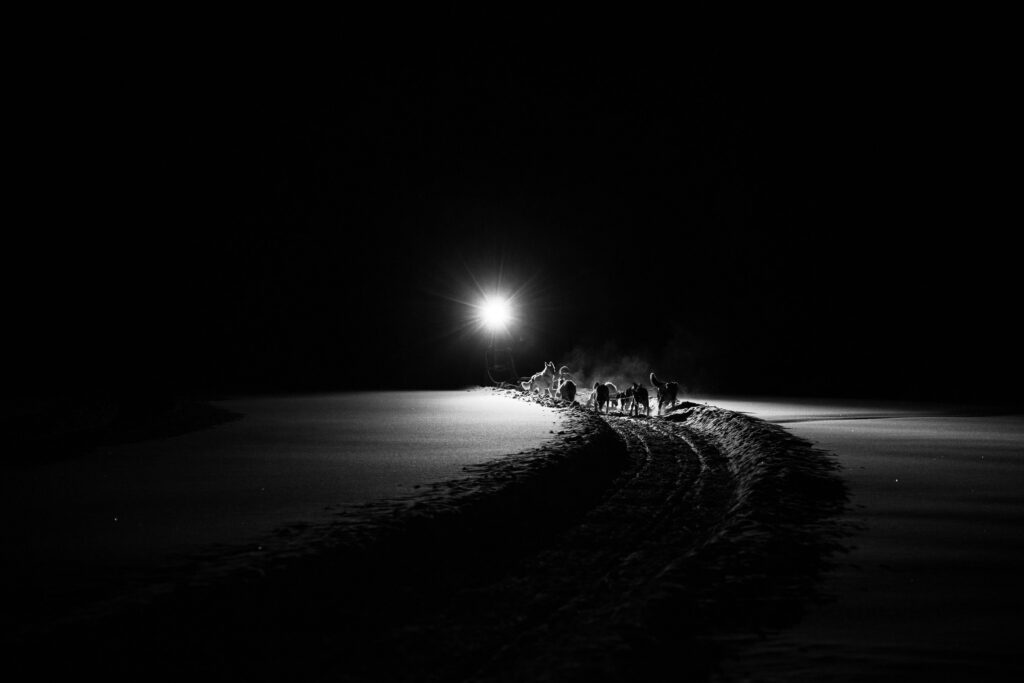
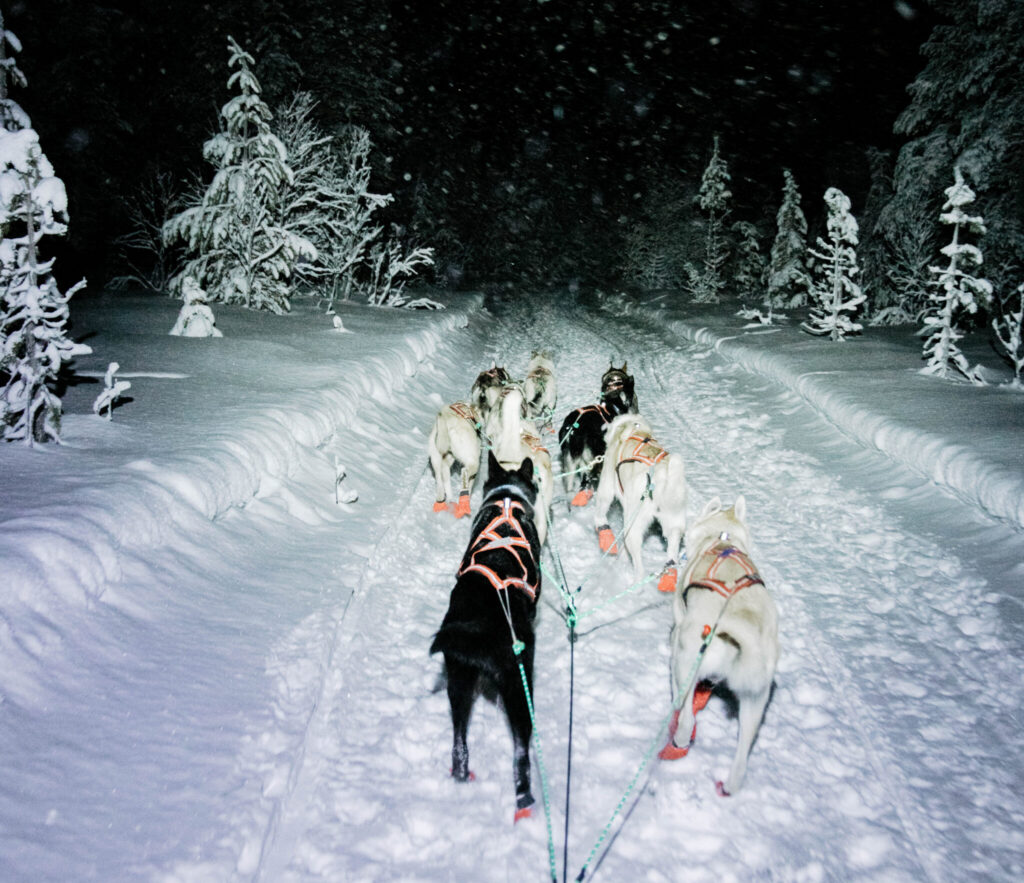
There was also a more immediate safety problem. Guests driving their own sled while staring at the sky instead of the trail is a recipe for accidents. Our guides need to watch the team, the trail and the people. The dogs need drivers who are paying attention. For us, the conclusion was simple: aurora hunting and self-drive husky tours are better kept as separate activities.
During the darker months, you may see the Northern Lights by chance on one of our late-afternoon programs. It has happened, and it is wonderful when it does. But it is a bonus, never part of our promise.
For a dedicated Northern Lights experience in Rovaniemi, we are happy to point guests toward specialists:
- Beyond Arctic – a strong choice for small-group aurora hunting with a particular focus on photography.
- Nordic Adventures – small-group experiences and several different ways to search for the lights.
- Green & Blue – family-focused programs designed especially with children in mind.
Whichever company you choose, read the description carefully. Ask whether the tour moves according to cloud conditions, what happens if the weather is poor, how long you may be outside, and whether photographs or thermal clothing are included.
Most importantly, understand that no honest company can guarantee auroras.
Our honest advice
Come to Lapland because you want to experience Lapland: the landscape, forests, darkness, stars, cold air, quiet and all the activities that make this place special. Then treat the Northern Lights as the extraordinary bonus they are.
Go outside. Give yourself several chances. Watch the clouds. Be patient. And if the sky stays quiet, do not let that make the whole trip a failure. Nature does not work to our timetable and, honestly, that is part of what makes the moment so special when the lights finally appear.