The year of the pup: Learning the sled dog world
By six months old, the puppies are not really tiny anymore.
They have legs. They have opinions. They have speed. They have enough confidence to make excellent choices and absolutely terrible ones, sometimes within the same five seconds.
This is the stage where we begin to introduce them more seriously to the world they will one day work in. Not by throwing them into hard training. Not by asking them to pull like adults. But by teaching the systems around sled dog life: adult dog groups, stakeouts, harnesses, lines, booties, food routines, rest, and eventually, very short first runs in front of a sled.
Between six and twelve months, the question is not: “How much can they do?”
The better question is: “How can we help them succeed and still want more?”
6-8 Months: Bigger dogs, still young dogs
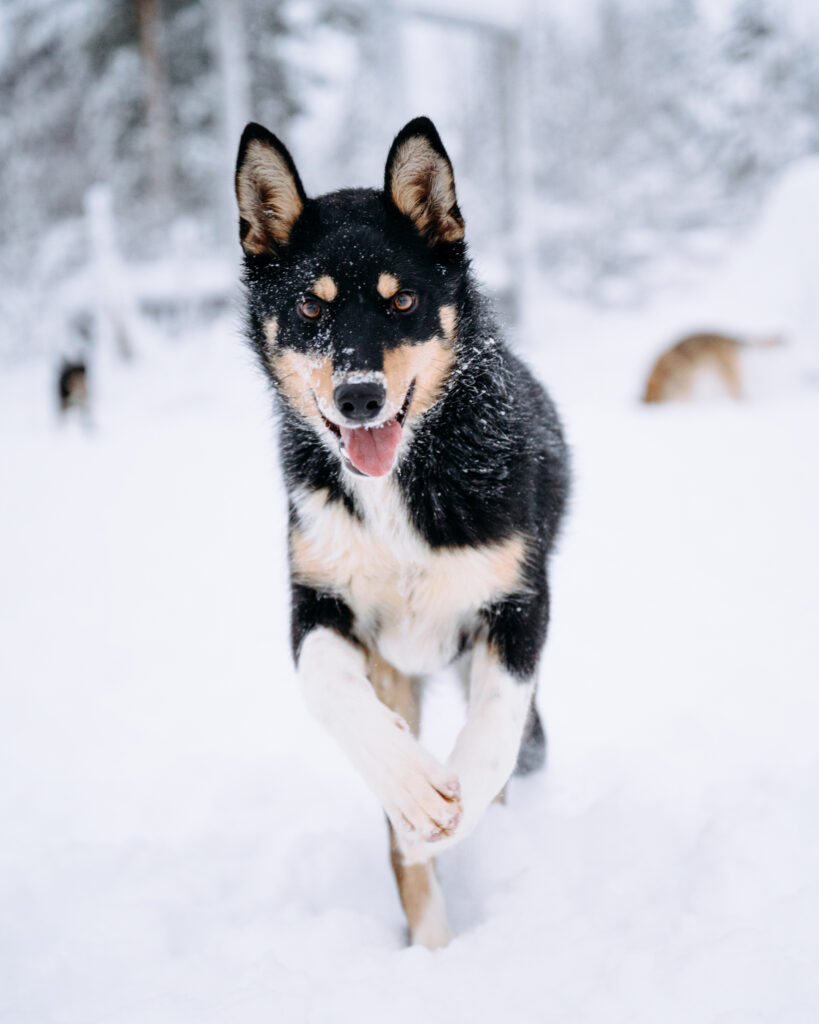
At six to eight months, the puppies begin to look like young athletes. This is dangerous.
Not because they are dangerous, though they can be impressively chaotic. It is dangerous because when a young dog looks strong, it becomes tempting to treat them as if they are already grown. But they are not.
They are still growing. Their bodies are still developing. Their minds are still maturing. They need more structure and more varied training, but they also need rest.
There is a fine line between doing enough and doing too much. With young dogs, we prefer to stay on the safe side of that line.
Adult dogs as teachers
At this age, we rotate different adult dogs with the pups.
This is not random. The adults we choose are part of the training. Puppies need to learn that not every adult dog behaves the same way. Some are playful. Some are calm. Some set clear boundaries. Some ignore nonsense until it gets too annoying. That variety matters.
A dog who can only live with one group or one personality type is harder to manage later. A dog who has grown up around different adults learns flexibility. They learn how to read social signals, how to adjust their behaviour, and how to settle into different group dynamics.
This is also part of preparing them for adulthood, working life, and eventually retirement. Adaptable dogs have more options.
New places, new situations
Socialisation continues, but now it becomes more varied.
We bring young dogs into new situations and places. New surfaces, new routes, new smells, new sounds, new equipment, new human routines. Not all at once. Not in a way that overwhelms them. Just enough to keep widening their idea of what “normal” can be.
This is one of the reasons puppy and young dog training is never only about pulling.
A good sled dog does not only need strong legs. A good sled dog needs a strong head. They need to cope with change, recover from excitement, and still listen when the world gets interesting.
Especially when the world gets interesting.
Health and feeding at six months
At six months, the puppies are dewormed again and then move toward the adult deworming schedule.
Feeding also changes around this stage. We can start mixing puppy food with adult 4800 Royal Canin food, often half and half. They may also begin eating more like adults: one main meal per day, plus souping when needed.
But food amounts are never just copied from one litter to another. We look at the dogs.
Some grow fast, some are lean, some are easy keepers, some burn everything immediately, some look like they are growing a new leg every week. So we adjust based on the litter and the individual.
At this age, body condition matters a lot. We want growing dogs to have enough fuel, but we do not want them heavy. Extra weight is not helpful for young joints, especially when they are beginning more structured movement.
More training, more rest
Training becomes more intensive and more versatile now.
The dog walker can become a bigger part of the routine. For older pups, sessions may become longer, always depending on the group. The goal is a nice trot, focus, and calm movement, NOT frantic running.
They may continue free running, leash work, group handling, and controlled time with adults. But the most important thing is that training still feels positive. Young dogs should finish with confidence, not exhaustion.
A tired dog is not automatically a well-trained dog. Sometimes a tired dog is just tired.
Introducing sledding basics
At six to eight months, we can slowly introduce the basics of sledding life.
And here is the important part: this does not mean they are pulling a sled. They are learning the world around sledding first.
They learn about harnesses, they learn about the stakeout, they learn about lines, they learn about booties, they learn that people may touch their paws, lift their legs, adjust equipment, and ask them to stand still in exciting places.
For a young dog, this is a lot.
Imagine being full of energy, surrounded by other excited dogs, attached to strange equipment, and expected to stay calm. That is a skill. It does not magically appear when the dog turns two. We build it slowly.
Stakeout training
The stakeout can be a strange experience for a puppy.
Suddenly they are attached to a chain and cannot move wherever they want. This can be frustrating. Some puppies accept it quickly. Others have feelings about it … many feelings.
We bring them to the stakeout one by one, with someone there to support them. We use snacks. We reward calm behaviour: sitting, lying down, relaxing, looking at us instead of turning into a dramatic spaghetti creature.
If they get wild, we redirect with simple exercises like sit or name training.
We also handle them on the stakeout. We touch paws, check their bodies, and make sure they learn that being attached does not mean something bad is happening. Later, when all the puppies are there, we may feed them on the stakeout.
Food arriving in a strange place makes the strange place less strange.
The next time, we might bring them to the stakeout, then go for a walk or run, then return. That gives the whole experience a positive rhythm: arrive, wait, good things happen, move, return, settle.
This is how a working routine begins.
Harnessing
Harnessing is introduced in the same way: gradually.
When the young dogs are big enough for the smallest harnesses, we may put one on and walk them back with a leash attached to the back loop. They feel the harness on their body. They learn that it does not hurt. They learn that movement can happen with this strange piece of equipment on.
We are not asking for pulling yet. We are building comfort.
A harness should become something familiar and exciting, not confusing or stressful.
8-12 Months: First time in front of the sled
By eight to twelve months, the young dogs have learned many of the basics.
They know more about harnesses, they know the stakeout, they have been handled in different places, they have met different adults, they have learned to move in groups, they have had time to grow.
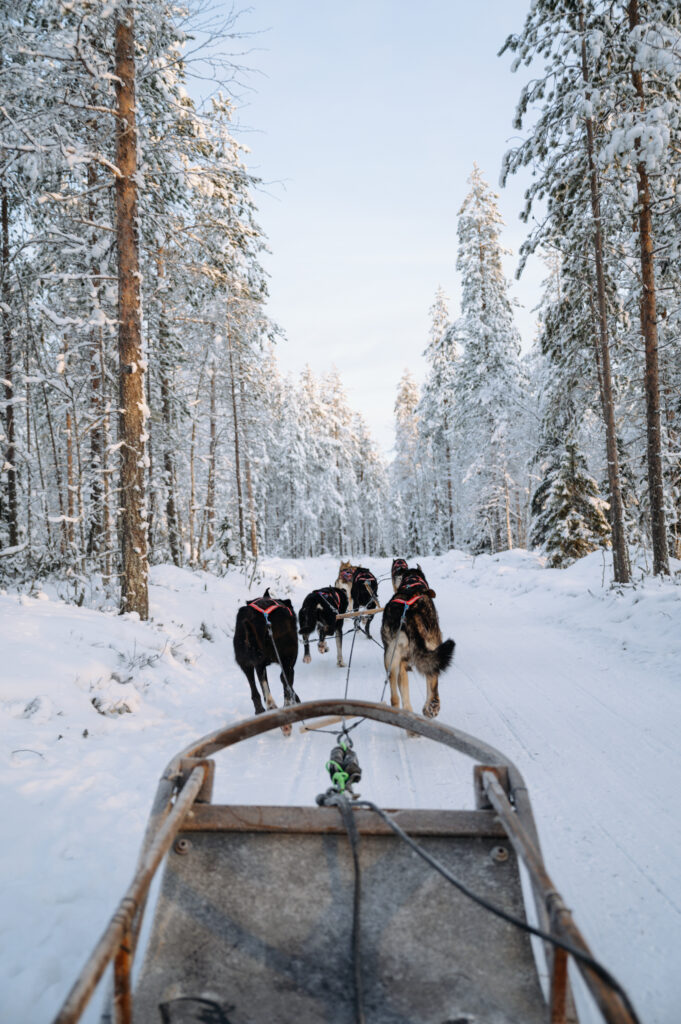
Now, carefully, they can begin to run in front of a sled.
The first sessions are short. Very, very short. Around one kilometre, without hills, just on flat ground, is enough. The goal is not distance, the goal is a good first experience.
We want them to come home with energy left.
That is extremely important. We do not want the first pulling sessions to end with tired, confused young dogs wondering why this exciting thing suddenly became too hard.
We want them thinking: “That was amazing. Can we do it again?
Why we keep it easy
Young dogs are naturally enthusiastic. Many of them will offer more than they should. That is why we have to be the sensible ones.
If we run them until they are tired, we may get one impressive-looking session, but we risk damaging the attitude we are trying to build. We want sledding to feel fun, exciting, and successful.
A young dog who finishes strong builds confidence. A young dog who finishes exhausted learns doubt.
We are not training for today. We are training for the next ten years of that dog’s life.
Moving toward adult food
Around this age, the young dogs can switch fully to adult food.
By now, they are moving closer to the feeding rhythm of the rest of the kennel. Still, we keep watching. Growth is not identical in every dog, and young dogs can change shape quickly. Food amounts depend on body condition, activity, season, weather, and the individual.
The feeding routine may look more adult now, but the eyes on the dogs stay just as careful.
New living arrangements
Around eight to twelve months, the bigger puppy fence may start to feel too small for these long-legged youngsters.
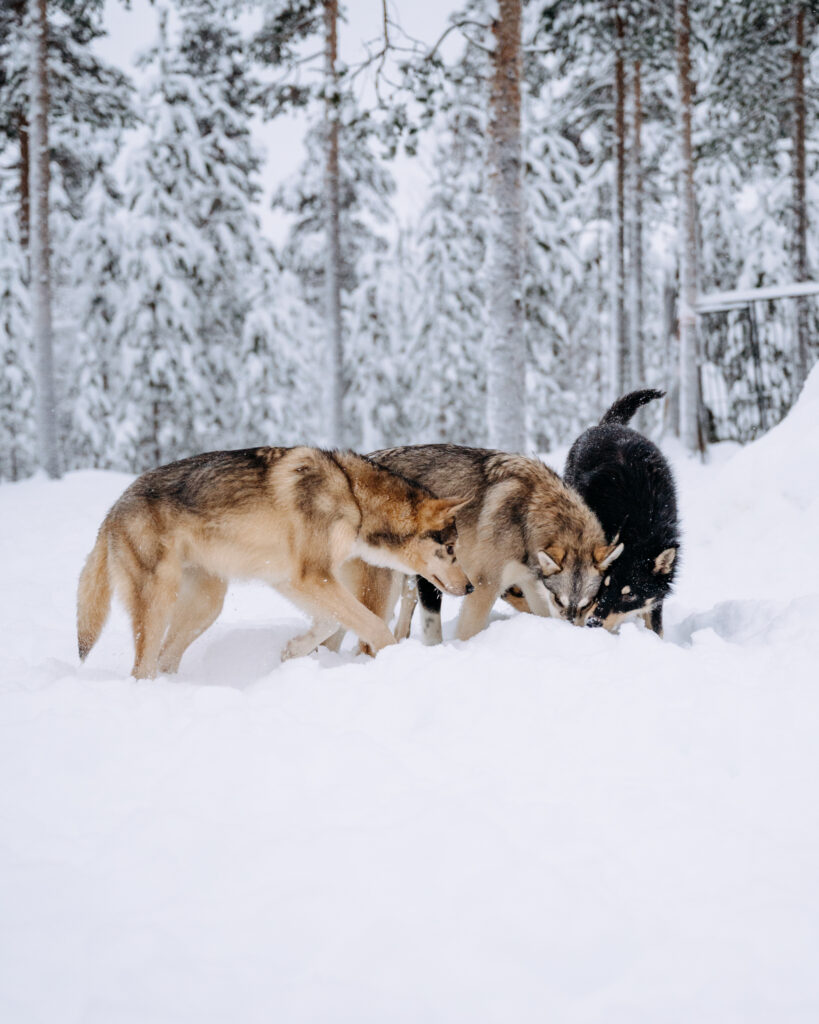
This is often when we begin pairing them with suitable adults. The right adult roommate can teach good habits: calm behaviour, social boundaries, appropriate play, and how to just exist without making everything into a project.
Choosing these pairings matters. We are not only asking, “Who fits where?” We are asking, “Who can help this young dog become better?”
The main goal of this stage
Between six and twelve months, the young dogs are introduced to the working world without being treated like full workers.
That distinction matters.
They learn equipment, they learn routines, they learn patience, they learn to handle excitement, they learn to live with different dogs, they learn that harnesses and sleds mean good things, they learn to finish a run and still want more.
This is the age where we protect their bodies and shape their attitude. Because a sled dog who loves the work is not made by forcing the work.
They are made by building success, one small step at a time.