The year of the pup: From tiny explorers to teenage trouble
In the first part of our puppy series, we followed the puppies from pregnancy through their first two months of life. That stage is all about the mother, milk, warmth, weighing, handling, and those first wobbly steps into the world.
Now things get louder.
Between two and six months, puppies start becoming proper little characters. They move faster. They test more. They explore further. Their confidence grows, and with it comes the first signs of the delightful chaos we call puppy training.
This is the age when we begin building the habits that will carry them into adulthood: following humans, walking on a leash, accepting new places, travelling calmly, interacting with other dogs, and learning that the world does not always go in the direction they expected.

2-3 Months: The world gets bigger
At two to three months, the puppies are no longer just babies in the doghouse. They are awake, curious, fast enough to get into trouble, and still small enough to be forgiven for most of it.
Their health routine changes again at this age. We weigh them twice a week now, instead of every other day. This still gives us a good picture of how they are growing, but without needing to put them on the scale constantly. Deworming continues every two weeks, and we keep using their weight to make sure the dosage is correct.
Handling continues as part of normal life. Nails, teeth, paws, hydration, body condition, skin, collars – all the boring things that matter. Health checks are not only about spotting problems early. They also teach puppies that being touched and checked is normal and safe.
A dog who has been handled calmly since puppyhood is much easier to care for later. That matters when they need a wound cleaned, a paw checked, a harness adjusted, or a vet visit.
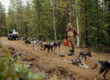
Forest walks without mum
Forest walks continue daily when the weather allows.
At this age, the mother can usually stay behind. This is a big developmental step. Until now, mum has been the puppies’ main reference point. She is comfort, confidence, direction, and authority.
But if we want sled dogs who focus on humans, we need to become important too.
Without the mother leading the way, the puppies begin to look to us. Where are we going? What are we doing? Why did the human suddenly stop? Why is the human hiding behind a tree like a suspicious forest creature?
Good questions. All part of the plan.
Wrong way training
Wrong way training is one of our favourite tools.
The idea is simple: when the puppies think they know where we are going, we change the plan.
If they run too far ahead, we stop, turn around, or hide. If they choose one path at a crossing, we go the other way. If they start predicting the route, we take a different route. Forest, swamp, lake edge, deep woods, running fence – different ground, different smells, different decisions.
The goal is not to trick them just for fun …well … not only for fun.
The real goal is focus. We want puppies who naturally check where the human is, instead of assuming the human will always follow them. On walks, we talk as little as possible. If they go too far, we disappear quietly. When they notice and come back, that is the moment we reward.
That is when we use “Kom maar!”
Timing matters. If a puppy is already running back toward us, the command gets attached to the right action. If the puppy is running away and ignoring us completely, shouting the command ten times only teaches them that the command can be ignored.
So first we teach the habit: check in with the human. Then we add the word.
Sitting before food – But don’t let them fail
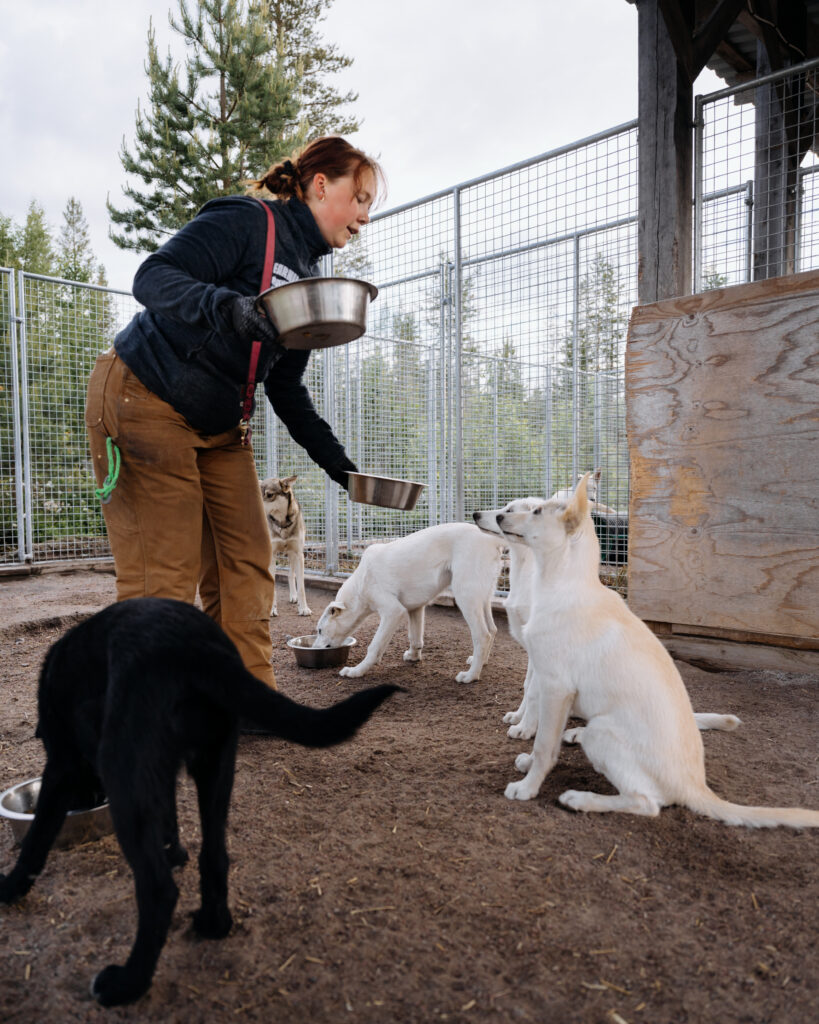
By this age, most of the puppies understand the idea of sitting before food.
We may ask them to wait a little longer, but we are careful. Puppy training should stretch them, not set them up to fail. If we ask for too much, they lose the plot, the group explodes into chaos, and then everyone has to reset – including the humans.
The rule stays simple: calm behaviour brings good things.
We also keep working on four paws on the ground. Jumping is not rewarded. It may be cute when they are small, but nobody wants an adult sled dog launching into them at full speed because “it was cute when he was little.”
It was cute. But it will not be cute in the future. So we teach it early.
Leashes, bigger collars, and the vet room
Around this stage, the puppies move into bigger collars and begin proper leash training.
A simple first exercise is walking them on a leash to the vet room and back. It sounds small, but it teaches many things at once: collar pressure, following a person, entering a different space, walking away from the group, and returning calmly.
The vet room itself is an important part of environment training. We do not want the vet room to be the place where only uncomfortable things happen. We want it to be normal, even positive.
As the puppies grow too big for the small weighing bag, we start using the vet room scale. The scale feels strange under their paws at first, so we reward them and take our time. Later in life, when a dog needs weighing, treatment, medication, or a check-up, this early familiarity makes everything easier.
This is one of those little routines that looks insignificant until the day it saves you a lot of stress.
Dog walker: The first introduction
Two to three months is also a good age to begin introducing the dog walker.
The Dog Walker is one of the most used training tools in our kennel, but for puppies, the first goal is not fitness. It is confidence.
We start slow. Doors open. Low speed. We walk inside with them. If they leave, that is fine. We call them back. The session should feel safe, easy, and almost boring.
Later, we close the doors. Then we stand outside. Then, slowly, we increase the time.
At the beginning, once a week for around 20 to 30 minutes is enough, depending on the litter. The important thing is that the dog walker becomes a nice place. Not forced, not scary, not overwhelming, but just part of everyday life.
3-6 Months: The teenage preview
By three months, the puppies are weighed once a week. Deworming continues every two weeks until four months. After that, the deworming rhythm changes, and their next scheduled deworming is at six months before they move toward the adult schedule.
Around this age, the mother is often getting tired of the puppies … understandably.
They are bigger, noisier, sharper, and much more convinced of their own brilliance. This is when we begin separating them more from the mother and introducing selected adult dogs.
Not just any adult dog. That would be asking for trouble.
We choose adults who are fair, socially skilled, playful enough to engage, and confident enough to set boundaries. A good adult dog can teach puppies things humans cannot teach quite as well. When to stop. When to calm down. How to read another dog. How not to be an idiot.
These are valuable lessons.
Puppy land, play, and social rules
As the litter grows, the puppy fence may become too small. Then we may split the litter into two groups or slowly move them out of puppy land.
Group dynamics matter. We watch who plays well, who gets overwhelmed, who becomes too pushy, and who needs a different setup.
Playing in puppy land is not just play. It is social training. Puppies learn from each other, but they also need guidance. Bullying is not allowed. If a puppy keeps harassing others and does not respond to correction, that puppy may go back to the fence for a break.
Not as punishment. As management.
Puppies are not born with perfect social skills. They learn them.
This is also the age when socialising with visitors can be useful, especially on tour days. But it must be managed. Puppies should not jump, bite, or scream their way into people’s arms. Guests may be given puppy kibble, but they also need to know about sharp teeth and puppy enthusiasm.
Socialisation does not mean uncontrolled chaos with an audience. It means good experiences, for puppies and people.
Flight boxes, trailers, and travel practice
At some point in a sled dog’s life, travel is almost guaranteed. To the vet, to a new trail, to a race, to another kennel, or to a future home. So we start early.
When the puppies are small, we may bring a flight box into their area while cleaning the doghouse. They can sniff it, climb in, find treats, or discover a toy inside. Later, we place a trailer in the running fence so they can approach it at their own pace.
Eventually, we begin short trailer rides with the ATV. For example, we may load the puppies into the trailer and drive them near the vet room for weighing. We use snacks and often put two puppies together so they do not feel alone.
Small steps. Always small steps.
The point is not to “get it done.” The point is to create dogs who can travel without panic.

Octopus training
Once the puppies have some leash experience, we can begin introducing the octopus belt.
This is how we often walk several dogs at once, so it matters that they understand the system. We start with one dog at a time. The goal is walking beside or behind the handler, not dragging in front.
If the puppy pulls, we stop. We guide them back into position. When they are in the right place, we continue. They learn that calm walking makes movement happen.
Only when one dog understands do we add another. Two dogs are more exciting than one dog. Three dogs are basically a committee. So we build slowly.
Again, the dogs are learning body language as much as words.
Five months: First ATV free running
Around five months, the puppies can begin short free-running sessions behind the ATV.
This is not hard training. It is not full speed. It is not “let’s see how tired we can make them”. They are still growing.
We take them in small groups, sometimes pairs. Before starting, we try to gather them behind the ATV with snacks, then move calmly onto the trail. The pace is easy jogging, perhaps around half to two-thirds of what they could do at full speed.
We stop often. We do focus exercises. If puppies go too far, we stop or reverse. We teach them not to rush toward roads. We keep using the same principles from wrong way training: pay attention, stay connected, follow the human.
The goal is not exhaustion. The goal is focus, confidence, and controlled movement.

Feeding through this stage
As the puppies grow, the food changes with them.
They need more energy as their bodies develop, but we do not just throw food at the problem. We look at the dogs. Are they too thin? Too heavy? Growing evenly? Eating well? Is the weather hot? Are they tired?
A safe adjustment is made gradually, not dramatically. More growth usually means more food, but the litter and the individual puppy always guide the decision.
Around five to six months, we begin slowly adding adult Royal Canin 4800 food to the puppy food. The transition is gradual, moving toward a half-and-half mix before they eventually join the adult feeding rhythm later.
On very hot days, training may be reduced, and puppies may get frozen puppy snacks. Because yes, even future sled dogs appreciate a summer treat.
Chaos with a purpose
Between two and six months, puppies learn an enormous amount.
They learn to walk on a leash, they learn to visit the vet room, they learn the scale is not a monster, they learn to follow humans without mum, they learn to travel, they learn social rules from other dogs, they learn that food comes to calm puppies, not screaming ones, they learn that humans are unpredictable in the forest and therefore worth watching.
This stage is busy. It is messy. It is full of corrections, resets, treats, mud, sharp teeth, and small victories.
It is also where the puppies begin to look less like babies and more like future sled dogs.
Still ridiculous, of course. But future sled dogs.