De-training after the season: Helping sled dogs come down safely
By the end of winter, our dogs are in a very particular state.
They have worked hard for months. They have pulled, trained, toured, recovered, eaten, slept, and repeated the same routines day after day. Their bodies are strong, their fitness is high, and their minds are tuned into the rhythm of the working season.
Sometimes the transition is gradual. The number of guests slowly decreases, the days get warmer, and the training load naturally begins to drop. Other years, the season ends almost overnight. The weather changes, the snow disappears, or we reach the final tour day on the calendar – and suddenly the whole routine in the kennel is different.
For the dogs, that change is not always easy.
Why we do not just stop
Any human athlete will understand this. If you have been training hard for a sport or competing intensely for a season, stopping completely from one day to the next can affect both your body and your mind.
Humans can usually put that change into perspective. We understand why the season has ended. We can rationalise it. We can tell ourselves that rest is necessary, that recovery is part of training, and that a quieter period is healthy.
Dogs do not process it that way. For them, the change simply happens.

One day, the kennel routine is busy and predictable. They are running, pulling, preparing, eating, and recovering according to a pattern they know well. Then suddenly, the pulling stops. The activity level drops. The expectations change.
But their bodies and minds are still ready for work. That is when problems can begin.
If we stop too abruptly, we often see the atmosphere in the kennel change. Dogs can become restless, noisy, agitated, and frustrated. Some become grumpy. Some start looking for conflict. The energy that was previously spent on work now has nowhere useful to go.
They are not being “bad.” They are fit, motivated working dogs who have lost their outlet too quickly.
That is why we treat the end of the season as a process, not an event.
The goal of de-training
Detraining is the gradual reduction of workload after a period of high physical activity.
For us, this usually happens in April or May, depending on the weather and the end of the tour season. The goal is to bring the dogs down from a high-intensity winter state into a lower-intensity spring and summer routine without creating unnecessary physical or mental stress.
This is not about making the dogs unfit. It is about allowing their bodies to recover while keeping their minds settled and their daily lives meaningful.
After a busy season, the dogs need time for their muscles, joints, tendons, and small accumulated stresses to recover. Like any athlete, they may have tiny strains, muscle tightness, or general fatigue that is not dramatic enough to be called an injury, but still needs time to repair.
At the same time, they cannot simply be left with nothing to do. So the challenge is balance:
- Reduce hard work.
- Maintain healthy movement.
- Keep routines predictable.
- Give the dogs enough activity to stay calm and happy.
- Allow the body to recover before building up again.
The two-to-three-week no-pulling period
One principle we like to follow is a two-to-three-week break from hard pulling work. This does not mean the dogs do nothing.
It means they are not asked to exert themselves at the same physical level as they did during the working season. No hard team runs. No heavy pulling. No demanding winter-style workload.
The purpose of this period is to let the dogs’ bodies heal and reset. It gives time for small muscle tears and general wear from the season to repair. It gives the joints and connective tissues a break from the repetitive strain of pulling. It also gives the dogs a mental pause from the intensity of winter work.
But a complete stop would usually be too much of a shock. So, instead of removing activity, we change the type of activity.
Light exercise, not hard work
During this no-pulling period, we focus heavily on low-intensity movement and enrichment.
One of our most useful tools for this is the dog walker. It allows the dogs to move in a very controlled way. We can regulate the speed, duration, and intensity of the session very precisely. The dogs get physical exercise, but without the emotional arousal and physical demand of pulling in harness.
It is movement without pressure.
This makes the dog walker especially useful after the season. The dogs can burn some energy, loosen their bodies, and keep a routine, while still recovering from the harder work of winter.
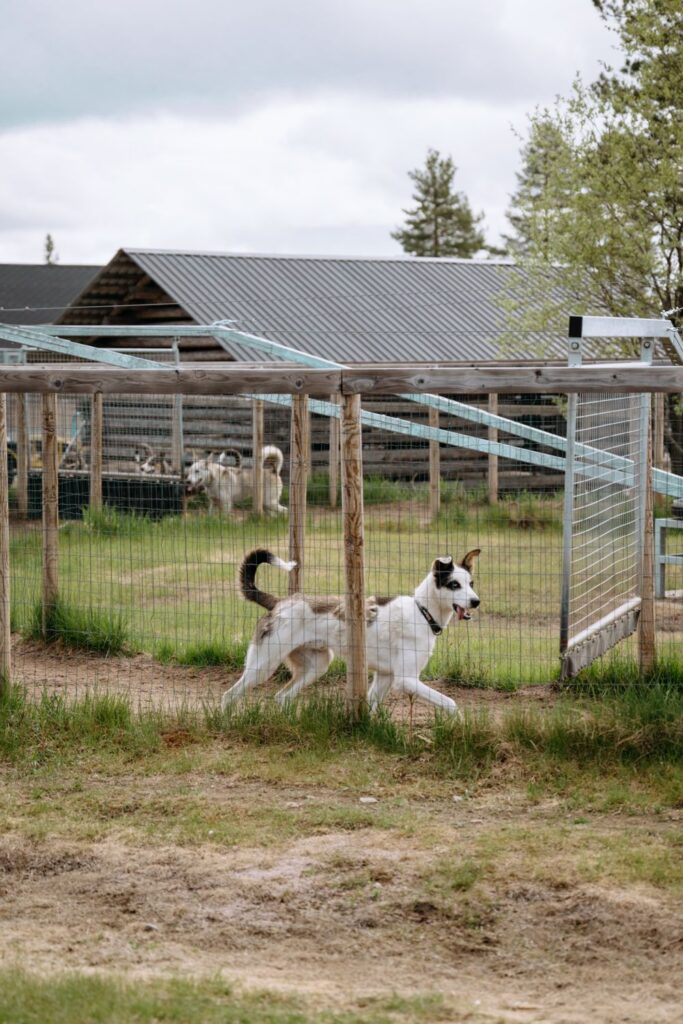
We also use free running a lot during this time. The dogs can run, play, sniff, interact, and blow off steam in a more natural way. Free running also gives us a good opportunity to start building and testing summer groups. We see which dogs work well together, who is relaxed with whom, and where the social dynamics need adjusting.
That mental side is important.
After winter, the dogs are not only physically fit; they are also mentally used to a lot of structure and stimulation. Free running, group work, and light training give them something to think about without putting too much load on the body.
Reintroducing pulling work
After the two-week healing period, or sometimes closer to three weeks depending on the dogs and the weather, we slowly reintroduce light pulling work. This may be once or twice a week, and only if temperatures are still low enough to do it safely.
The idea is not to train hard. It is simply to remind the dogs that pulling is still part of life. We do not want to completely drop the routine and then suddenly restart it months later. Instead, we want a gradual transition from winter intensity to summer maintenance. The dogs stay connected to the work, but the workload is much lighter.
This helps both physically and mentally. Their bodies keep some familiarity with pulling, and their minds stay reassured that the routine has changed, but not disappeared.
Summer activity: Still busy, just different
By summer, the kennel has a very different rhythm from winter.
We are no longer asking the dogs to perform high-intensity sled work, but we still want them active, healthy, and mentally balanced. In a normal summer routine, we aim to get the dogs out and doing something at least four to five times per week, depending on the weather and the needs of the individual dogs. That activity can take many forms:
- Dog walker sessions
- Free running
- Leash walks
- Young dog training
- Swamp training
- Trips to the lake
- Light cart work when conditions allow
- Social group work and handling practice
The exact routine changes with temperature, ground conditions, age groups, and the dogs’ individual needs. Young dogs may do more free running and environmental training. Older dogs may need gentler movement. Some dogs benefit from structured walker sessions; others need more social time or mental challenges.
The point is not to train every dog in the same way. The point is to keep everyone moving, thinking, and comfortable.
Managing the mental transition
One of the most important parts of de-training is expectation management.
During winter, dogs learn the rhythm of work. They know when things happen. They hear the sounds of preparation. They understand the energy of the kennel before a run. When that suddenly disappears, it can create frustration.
So we try to replace the winter routine with another routine.
It does not have to be as intense. It does not have to involve pulling. But it does need to be predictable enough that the dogs understand life still has structure.
A dog who gets regular walker sessions, free running, handling, water refreshes, feeding routines, and calm human interaction is much more likely to settle into spring than a dog who simply goes from full work to nothing.
This is especially true in a large kennel, where the general atmosphere matters. Restless dogs influence each other. Noise creates more noise. Frustration spreads quickly.
A good spring routine keeps the kennel calm.
Recovery is part of training
It is tempting to think that training only means building fitness. More kilometres, more runs, more strength, more speed. But recovery is training too.
A dog that is never allowed to properly recover will not become stronger. A dog that is dropped too suddenly from full work to complete inactivity may become frustrated, stiff, or difficult to manage. The best results come from understanding that fitness is not a straight line. It rises, peaks, settles, and builds again. Our job is to guide that process.
In autumn, we build the dogs up for work. In winter, they give us their full power. In spring, we bring them down carefully. In summer, we maintain activity and general condition. In autumn, we begin building again.
Each phase matters.
A controlled change, not a hard stop
So when we talk about de-training sled dogs after the season, we are not talking about stopping life in the kennel. We are talking about changing the type of work.
- From hard pulling to light movement.
- From winter intensity to spring recovery.
- From team work to individual observation.
- From high physical output to maintenance, healing, and balance.
The dogs have given us a full season of effort. They deserve a transition that respects both their bodies and their minds.
For us, good de-training means reducing the workload gradually, giving the dogs a proper break from hard pulling, using tools like the dog walker and free running to keep them active, and then slowly reintroducing light work when the time is right. It is not complicated, but it does require attention.
And like many things in a sled dog kennel, the best results come from reading the dogs, respecting the season, and keeping the system simple enough that it can be done well every day.